.png)
Published August 22, 2026
How to Use Your Home Equity to Buy Your Next House


If you own a home in Evansville, Newburgh, or elsewhere in Southwest Indiana and you're thinking about moving, there's a good chance a significant portion of your wealth is tied up in your current house.
That creates a common problem:
How do you use the equity in your current home to buy your next home if you haven't sold yet?
Maybe your family needs more space and you're ready to move up. Maybe you're an empty nester who wants to downsize. Or perhaps you've simply found a home that fits your life better.
Whatever the reason, many homeowners assume they have to sell their current home first to access their equity.
That's not always the case.
There are several strategies that may allow you to access your home's equity, purchase your next property, and then sell your current home afterward.
Let's start with understanding how much equity you actually have.
Watch my full video breakdown by clicking here.
What Is Home Equity?
Home equity is essentially the difference between what your home is worth and what you owe against it.
For example, let's say your home is currently worth $350,000 and you owe $200,000 on your mortgage.
Your estimated gross equity would be:
$350,000 home value – $200,000 mortgage balance = $150,000 gross equity
That doesn't necessarily mean you'll walk away from the sale with $150,000, though.
You'll also need to account for the expenses associated with selling your home.
Gross Equity vs. Net Equity
Gross equity is a good starting point, but what really matters when planning your next purchase is your estimated net equity.
Your net equity is approximately what remains after paying off your mortgage and accounting for the expenses associated with selling.
Those expenses could include things such as:
- Title-related expenses
- Property taxes
- Professional real estate fees
- Inspection-related repairs
- Home warranties
- Surveys
- Other expenses negotiated as part of the purchase agreement
The exact amount will depend on your property and how the transaction is negotiated.
As a rough planning estimate, selling expenses can sometimes fall within a range of approximately 5% to 10% of the home's sales price. That's a wide range, which is why it's important to evaluate your individual situation rather than relying solely on an online calculator.
How Do You Know What Your Home Is Worth?
Before you can calculate your equity, you need a reasonable estimate of your home's current market value.
You can start with an automated home valuation tool to get a rough estimate.
At Dauby Real Estate, you can visit DaubyRealEstate.com/homevalue and enter your address to receive an estimated value.
Keep in mind that automated valuations aren't appraisals or professional comparative market analyses. Sometimes they're high, sometimes they're low, and sometimes they're fairly accurate.
If you're seriously considering making a move, a better approach is to have a real estate professional walk through your home and prepare a comparative market analysis based on its condition, features, location, recent comparable sales, and current competition.
That's particularly important when you're using the estimated proceeds from your current home to plan the purchase of your next one.
Do You Need 20% Down to Buy Your Next House?
One misconception we hear from homeowners is that they'll need a 20% down payment to purchase their next home.
That's not necessarily true.
There are a variety of mortgage options available with different down-payment requirements. For example, FHA financing commonly allows qualified borrowers to purchase with a 3.5% down payment.
The appropriate loan and down payment will depend on your financial situation and the property you're purchasing.
And that's where things get particularly interesting for homeowners with substantial equity.
You may have enough wealth tied up in your current home to make the next purchase—you just need a strategy for accessing it.
How Can You Buy Before You Sell?
The simplest approach is obviously to sell your current home, receive the proceeds, and then purchase another property.
Financially, that can make a lot of sense.
Logistically, however, it can create challenges.
What if you sell your house and can't find another home you like?
What if your closing dates don't line up?
Do you move into temporary housing?
Do you put your belongings into storage?
Another option is making an offer on your next home that's contingent upon the sale of your current property.
We've helped many Southwest Indiana homeowners successfully use contingent offers, but they're not ideal in every situation. If the home you're trying to purchase is attracting significant interest from other buyers, a seller may prefer an offer that isn't dependent upon another property selling.
Fortunately, there may be additional financing strategies available.
Click here to visit our in depth article about if you should buy or sell first.
The Contract Contingency Crusher
Through our relationship with Envoy Mortgage, there are several programs designed to address different challenges homeowners can encounter when trying to buy before selling.
The right solution depends on your financial situation, available equity, financing qualifications, and the home you're trying to purchase.
Here are several of the options discussed in the video.
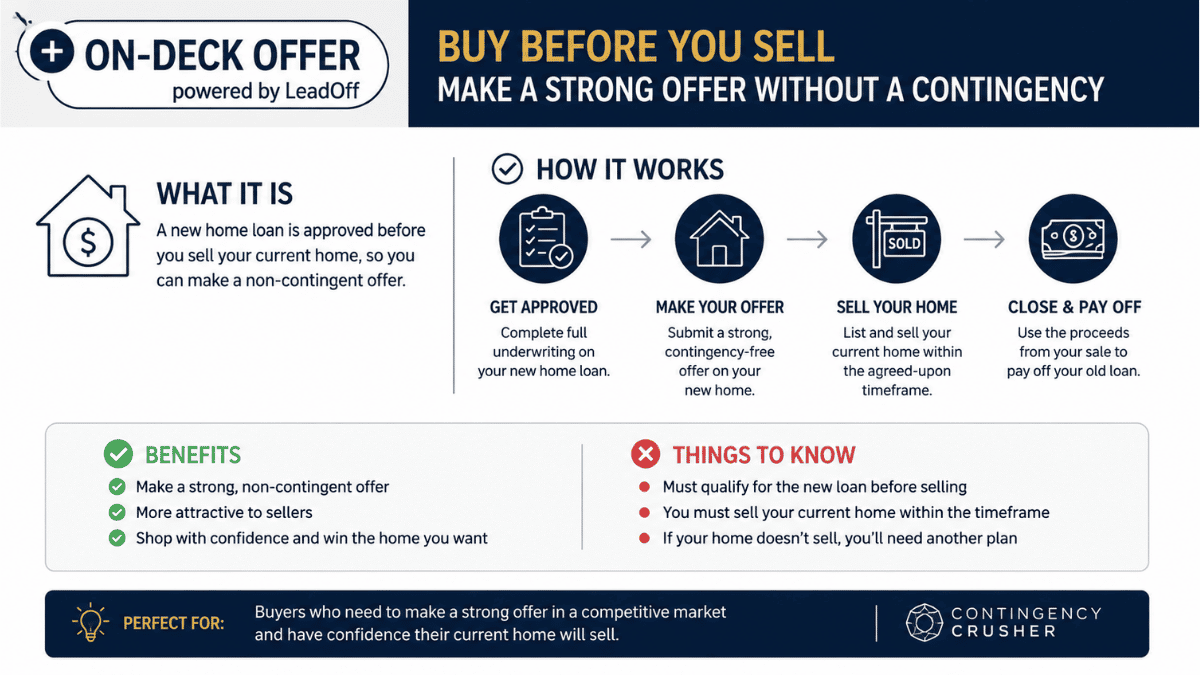
Option 1: On-Deck Offer
An On-Deck Offer may be an option when a homeowner doesn't qualify for the new mortgage while also carrying the existing mortgage payment and needs to eliminate the contingency of selling the current home before purchasing the next one.
According to the program information provided to us, it can be used with qualifying conventional financing with at least 5% down and an eligible property purchase price below $1.25 million. Program terms and qualification requirements apply.
The potential advantage is significant:
Instead of making your purchase dependent upon selling your current property first, you may be able to move forward with the new home and sell your existing property afterward.
Option 2: Envoy Equity Bridge
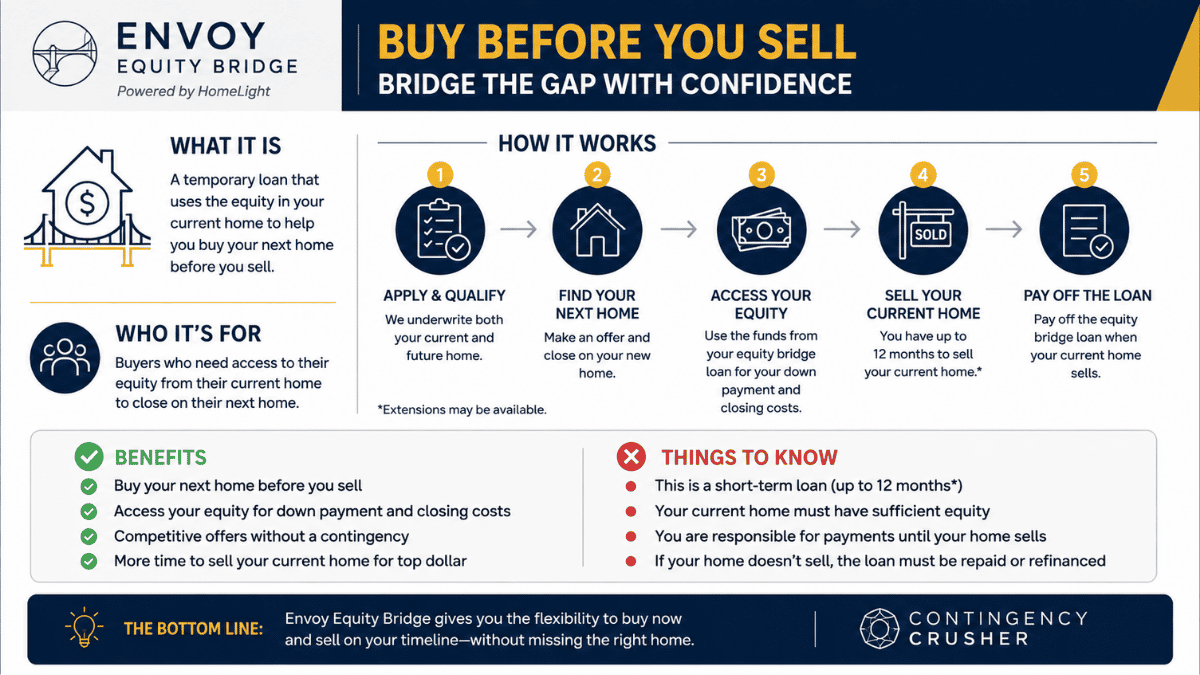
The Envoy Equity Bridge addresses a slightly different problem.
You may have plenty of equity in your current house, but that money isn't sitting in your checking account—it's tied up in the property.
An equity bridge may allow a qualified homeowner to tap into existing home equity for purposes such as a down payment on the next home or preparing the current home for sale.
This can create additional flexibility for homeowners who want to buy first and sell afterward.
Option 3: 5-Day HELOC
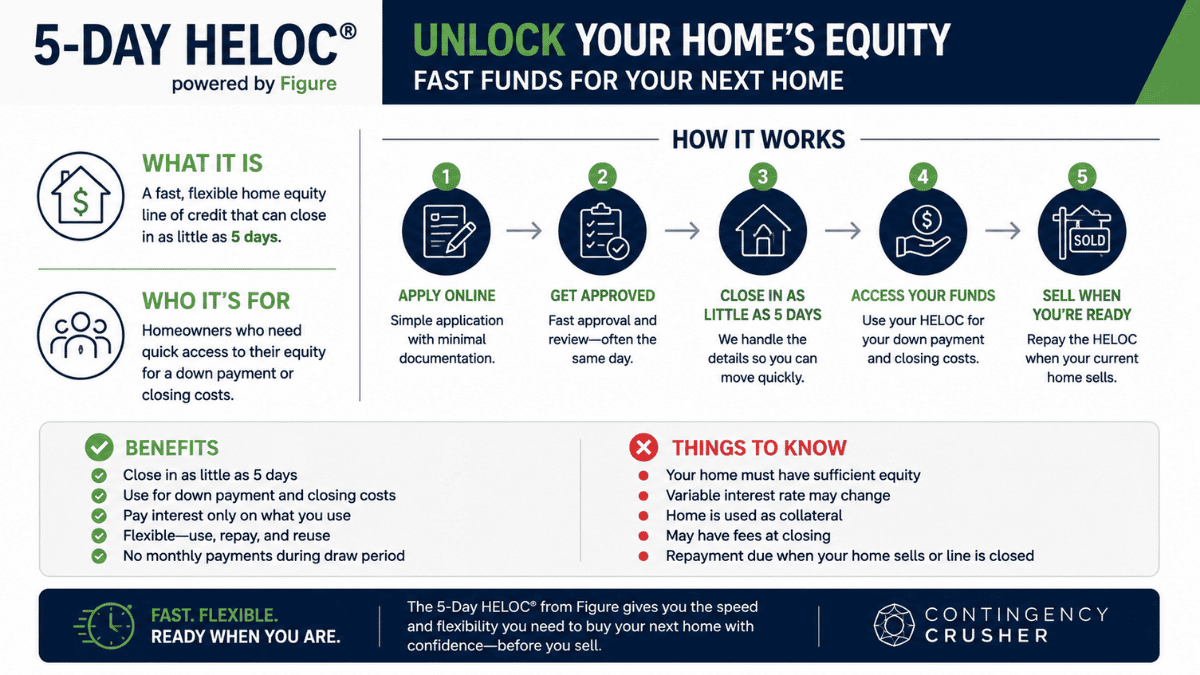
Another potential solution is a 5-Day HELOC.
This may be useful for a homeowner who can qualify for the new mortgage while still carrying the existing mortgage but needs access to the equity in the current home for the down payment or closing costs on the next purchase.
Instead of waiting until the current house sells to access that money, a HELOC may provide a way to access qualifying equity sooner.
As with any financing product, qualification requirements, costs, and other terms apply.
Option 4: Envoy Cash Edge
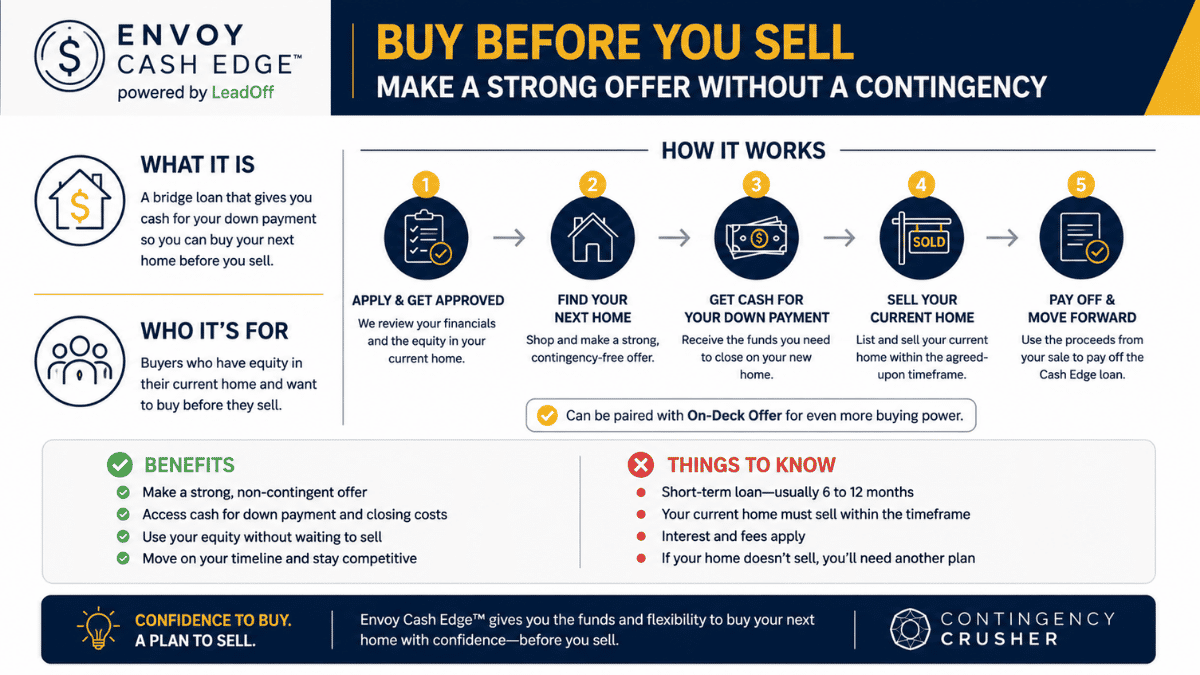
The Envoy Cash Edge is designed for another challenge: making your offer more competitive.
Imagine you've found the house you really want, but there are several interested buyers.
A traditional offer with a home-sale contingency may put you at a disadvantage.
Cash Edge may allow a qualifying buyer to structure the purchase as a cash offer even though the ultimate purchase involves financing.
This can be particularly valuable when you're trying to purchase a home that's likely to receive significant buyer interest.
Which Buy-Before-You-Sell Option Is Right for You?
This is the important part:
There isn't one program that's right for everyone.
Before deciding how to structure your move, I'd want to understand several things:
How much is your current home worth?
How much do you owe on it?
How much net equity are you likely to have?
Can you qualify to carry both mortgages temporarily?
How quickly is your current home likely to sell?
How competitive is the market for the home you want to purchase?
How comfortable are you with the financial risk of buying before selling?
Once we understand those answers, we can begin putting together a strategy.
Sometimes selling first is still the best decision.
Sometimes a contingent offer makes the most sense.
And sometimes one of these financing options may provide the flexibility you need to buy your next home before selling your current one.
You Have More Options Than You May Think
This is the biggest takeaway.
If you've built substantial equity in your home but feel like you're stuck because you don't know how to access it, don't automatically assume you have to sell your house before you can start looking for your next one.
You may have options.
The first step is understanding what your home is worth, approximately how much equity you have, and what your financial situation allows you to do.
From there, we can build a strategy around your situation instead of trying to force your move into a one-size-fits-all process.
Thinking About Moving in Southwest Indiana?
If you're considering moving up, downsizing, or purchasing another home in Evansville, Newburgh, Santa Claus, Boonville, Princeton, or elsewhere in Southwest Indiana, I'd be happy to help you start putting the pieces together.
We can begin by evaluating your current home, estimating its market value and potential net proceeds, and discussing the different ways you could structure your next purchase.
If one of the financing programs discussed above looks promising, we can also connect you with Envoy Mortgage to review the qualification requirements, costs, payments, and other details.
Call or text Trae Dauby at 812-777-4611 or visit DaubyRealEstate.com.
Loan programs are subject to qualification, credit approval, program availability, terms, conditions, and other restrictions. Consult with a qualified mortgage professional for information specific to your financial situation.
Frequently Asked Questions
Can I use the equity in my current home to buy another house?
Potentially, yes. Depending on your financial situation and available equity, options such as bridge financing or a home equity line of credit may allow you to access equity before your current home is sold.
Do I have to sell my house before buying another one?
No. Selling first is one strategy, but you may also be able to buy first, make a contingent offer, or use a financing strategy that helps you access your existing equity.
How do I calculate how much equity I have in my house?
Start by estimating your home's current market value and subtracting the debt secured by the property. For example, a $350,000 home with a $200,000 mortgage would have approximately $150,000 in gross equity. Selling expenses would then need to be considered to estimate net equity.
Can I use my home equity for the down payment on another house?
Depending on your qualifications and financing strategy, you may be able to access equity from your current property to help fund the down payment or closing costs on another home.
What is a bridge loan when buying a house?
A bridge-type financing solution is designed to help bridge the financial gap between purchasing your next property and selling your current one. The specific structure, costs, requirements, and repayment terms vary by program.
Is buying before selling better than making a contingent offer?
It depends on your situation. An offer that isn't contingent upon selling another property can sometimes be more attractive to a seller, particularly in a competitive situation. However, buying first can also create additional financial risk, so the decision should be based on your finances and the specific properties involved.
About Trae Dauby
Trae Dauby is the founder of Dauby Real Estate and has been helping buyers and sellers throughout Southwest Indiana for more than a decade. Under his leadership, Dauby Real Estate has helped more than 3,500 families buy and sell homes and has earned more than 800 five-star Google reviews.
Trae and the Dauby Real Estate team serve homeowners throughout Evansville, Newburgh, Warrick County, Vanderburgh County, and communities across Southwest Indiana. He regularly shares local housing market updates and practical real estate education designed to help homeowners make more informed decisions about buying and selling.