
Published September 25, 2026
Evansville Housing Market Update: More Homes Are Hitting the Market

The number of homes for sale in Evansville, Indiana has increased significantly over the last two months. But does that mean we’re finally moving toward a buyer’s market?
Not quite—but the market is changing.
In July, there were 404 homes for sale in Evansville. That increased to 489 in August and reached 590 homes in September—a roughly 46% increase in just two months.
More inventory means buyers have more options, and sellers are facing more competition. Here’s what the latest Evansville housing market numbers mean if you’re thinking about buying or selling a home.
Evansville Housing Inventory Is Growing
The number of homes available isn’t the only figure that has increased. Months of supply has also risen.
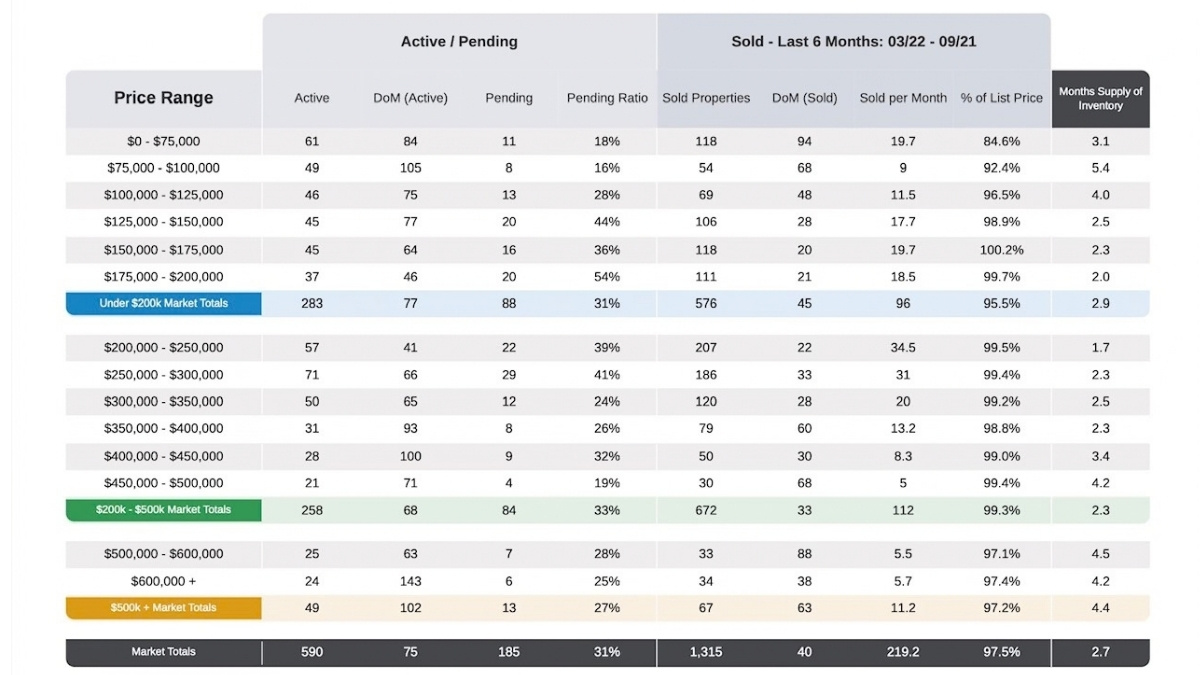
Evansville had approximately 2.1 months of housing supply in July, and that figure has now climbed to 2.7 months in September.
Generally, less than five months of supply is considered a seller’s market, five to seven months is considered more neutral, and more than seven months indicates a buyer’s market.
So, Evansville is still in seller’s-market territory, based on those benchmarks. However, the increase in inventory means sellers are competing against more homes than they were just a couple of months ago.
Sellers Are Having to Negotiate More
We can see that shift showing up in what sellers are receiving for their homes.
In September, Evansville sellers received an average of 97.5% of their final list price, down from 98.5% in August.
There’s another number that tells an important part of the story: sellers received approximately 95.9% of their original list price.
Why the difference?
The final list price is the price a home was being advertised for when the offer was received. The original list price is what the seller asked when the property first hit the market.
That gap suggests that price reductions are playing a role in getting some Evansville homes sold.
For sellers, that makes pricing correctly from the beginning increasingly important.
The Average Evansville Home Price Dipped—but There’s More to the Story
The average sales price in Evansville decreased from approximately $245,000 to $242,000.
At first glance, that might look like home values are falling. But one unusual transaction had a meaningful effect on September’s numbers.
An investor package containing 35 homes priced below $75,000 sold during the period. In total, 118 properties under $75,000 sold, compared with closer to 75 the previous month.
That concentration of lower-priced sales pulled down the overall average.
This is a good example of why you shouldn’t use one market statistic by itself to determine what your home is worth.
A home in Downtown Evansville, a property on acreage outside the city, and a home in another Southern Indiana community can all behave very differently.
Homes Are Still Selling in Evansville
Growing inventory doesn’t mean buyers have stopped purchasing homes.
Over the most recent six-month period covered in this update, 1,315 Evansville homes sold, compared with 1,250 during the comparable six-month figure used in the previous month's update.
That’s 65 additional sales.
At the same time, inventory continued to grow. In other words, homes are selling, but new inventory is coming onto the market fast enough to increase the overall number of available properties.
Homes also took an average of approximately 40 days to sell, compared with 38 days in the previous month.
The 35-property investor package affected this number as well because those properties spent a substantial amount of time on the market.
Your Price Range Matters
One of the biggest takeaways from this month’s numbers is that there isn’t one single Evansville real estate market.
Conditions vary considerably depending on price.
The under-$125,000 portion of the market showed more room for negotiation. The investor package had an especially large impact below $75,000, where 118 properties sold and sellers received approximately 85% of their list price.
Between approximately $125,000 and $500,000, sellers generally maintained stronger negotiating positions, with many price ranges averaging close to or above 99% of final list price.
Homes between approximately $200,000 and $500,000 also averaged around 33 days on market, compared with approximately 45 days below $200,000.
Above roughly $450,000, supply exceeded four months, bringing that segment closer to neutral-market conditions than lower price ranges.
And above $500,000, homes averaged approximately 63 days on the market.
The takeaway is simple: the market for a $175,000 home can look very different from the market for a $550,000 home.
Mortgage Rates Are Another Factor to Watch
Mortgage rates have moved higher this year. Freddie Mac reported that the average 30-year fixed mortgage rate reached 7.03% as of September 24, 2026, compared with 6.30% one year earlier.
Higher rates can affect purchasing power and monthly payments, which can influence both buyers and sellers.
For buyers, trying to perfectly time mortgage rates can be difficult because no one knows exactly where rates will go next. Instead, it’s important to look at the payment, purchase price, available inventory, and your own financial situation together.
For sellers, higher borrowing costs can reduce some buyers’ purchasing power. Combined with rising inventory, pricing and preparing your home correctly become even more important.
What Does This Mean for Evansville Home Sellers?
If you’re planning to sell, this market requires a little more preparation than sellers may have needed during the extremely competitive markets of 2020 and 2021.
With more homes available, buyers can be more selective.
That means pricing your home correctly from the start, decluttering, deep cleaning, touching up paint, completing small repairs, and presenting the property well can all matter.
And remember, market conditions can vary even within Southern Indiana. A home on several acres outside Evansville may have a completely different buyer pool than a home near Downtown Evansville or a property in Newburgh, Haubstadt, or another nearby community.
What Does This Mean for Evansville Home Buyers?
More inventory gives buyers more homes to choose from than they had earlier this summer, and some segments of the market are showing more room for negotiation.
But that doesn’t mean every buyer suddenly has the upper hand. Properties in certain price ranges are still selling relatively quickly, and market conditions can change significantly depending on location and price.
Instead of trying to determine whether it’s universally a “good” or “bad” time to buy, look at the numbers that apply to the type of home, price range, and Southern Indiana community you’re considering.
Thinking About Buying or Selling in Southern Indiana?
General Evansville market statistics are helpful, but your property and situation are unique.
If you’re considering selling, knowing your home’s current value is a good place to start.
Thinking about selling?
Click here to find out what your home could be worth.
If you’re considering buying, you can see what’s currently available and narrow your search by location, price, and other criteria.
Looking to buy a home in Southern Indiana?
Click here to start your home search.
About Trae Dauby
Trae Dauby is the founder of Dauby Real Estate, serving buyers and sellers throughout Evansville and Southern Indiana. Dauby Real Estate has helped more than 3,500 families with their real estate needs.
Trae creates educational real estate content to help local homeowners and buyers understand market conditions and make informed decisions about buying and selling.
Call or text: 812-777-4611
Website: DaubyRealEstate.com