.png)
Published September 3, 2026
Can You Really Afford to Move? The Numbers You Need to Know Before Buying Your Next Home


Maybe you've thought about making a move.
You'd like a bigger home. Maybe you're ready to downsize. Or perhaps your current home simply doesn't fit your life anymore.
But there's one question stopping you:
Can we really afford to move?
If you've owned your home for several years, you may have built significant equity. But having equity doesn't automatically mean moving makes financial sense.
Before you start looking at houses, there are a few important numbers you should understand.
At Dauby Real Estate, we've helped more than 3,500 families throughout Southwest Indiana, and one of the biggest things we encourage homeowners to do is develop a financial picture of their move before they fall in love with the next house.
Here's where I recommend starting.
Click here to watch my full video explaining by clicking here.

1. What Is Your Current Home Worth?
The first number you need is the approximate market value of your current home.
This matters because your home's value is the starting point for determining how much equity you have available for your next move.
There are plenty of online home-value tools that can give you an initial estimate. We also offer an online home-value tool through Dauby Real Estate. Click here to find out the value of your home.
These automated estimates can be useful for getting you in the ballpark, but they're just that, an estimate.
An automated valuation can't necessarily account for everything a buyer will see when they walk through your house, including:
- The condition of your home
- Updates and renovations
- Floor plan
- Interior finishes
- Deferred maintenance
- Unique property features
When you're getting serious about moving, that's when I'd recommend having a real estate professional actually walk through your property and prepare a comparative market analysis.
That gives you a much better idea of what your home could realistically sell for in today's market.
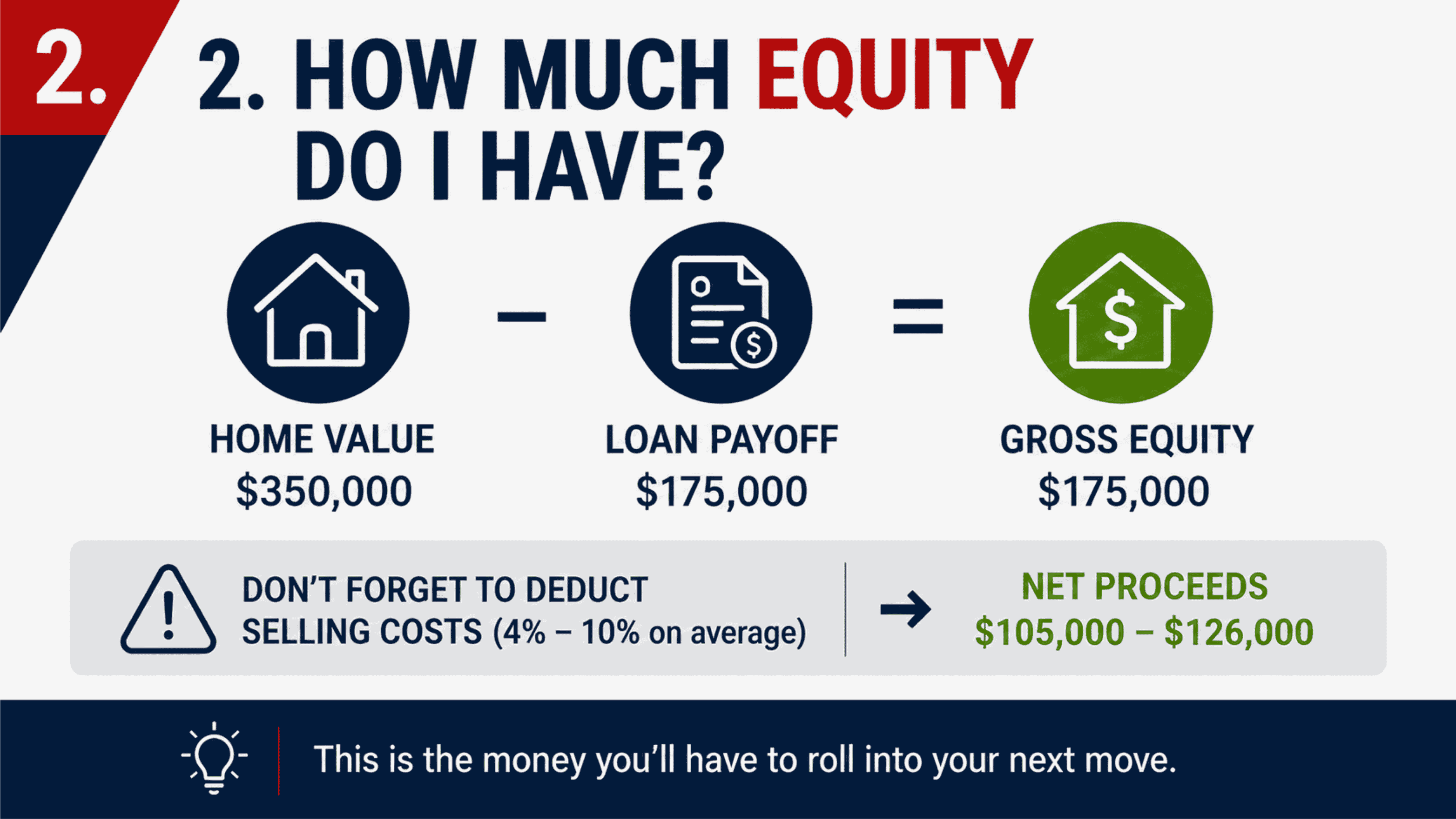
2. How Much Equity Do You Have?
Once you have an estimated value, the next question is:
How much equity do I have?
The basic calculation is pretty simple:
Estimated Home Value – Mortgage Payoff = Gross Equity
For example, if your home is worth $400,000 and you owe $175,000 on your mortgage:
$400,000 – $175,000 = $225,000 in gross equity
But there's an important distinction here.
That doesn't necessarily mean you're going to walk away from closing with $225,000.
Account for the Cost of Selling
There are expenses associated with selling a home that need to be considered when estimating your net proceeds.
Those could include things such as:
- Title-related expenses
- Inspection negotiations or repairs
- Buyer closing-cost negotiations
- Professional real estate fees
- Other transaction expenses
As I discussed in the video, we often use a broad initial estimate of approximately 4%–10% of the sale price, depending on the transaction and what you're ultimately able to negotiate.
This isn't meant to be an exact quote of what selling your home will cost. It's simply a starting point for planning.
Once we know more about your property and situation, we can develop a more specific estimate.
The goal is to determine approximately how much money you'll actually have available to put toward your next home.
3. What Will Your Next Home Cost Each Month?
This is where I think homeowners sometimes focus on the wrong number.
Instead of only asking:
"How expensive of a house can I buy?"
I think you should also be asking:
"What will this house cost me every month?"
Ultimately, that's the number you're going to live with.
Your monthly housing expense can include:
Principal + Interest + Property Taxes + Homeowners Insurance + HOA fees, if applicable
And the purchase price alone doesn't tell you what that payment will be.
Your down payment, interest rate, loan term, property taxes and insurance all affect the number.
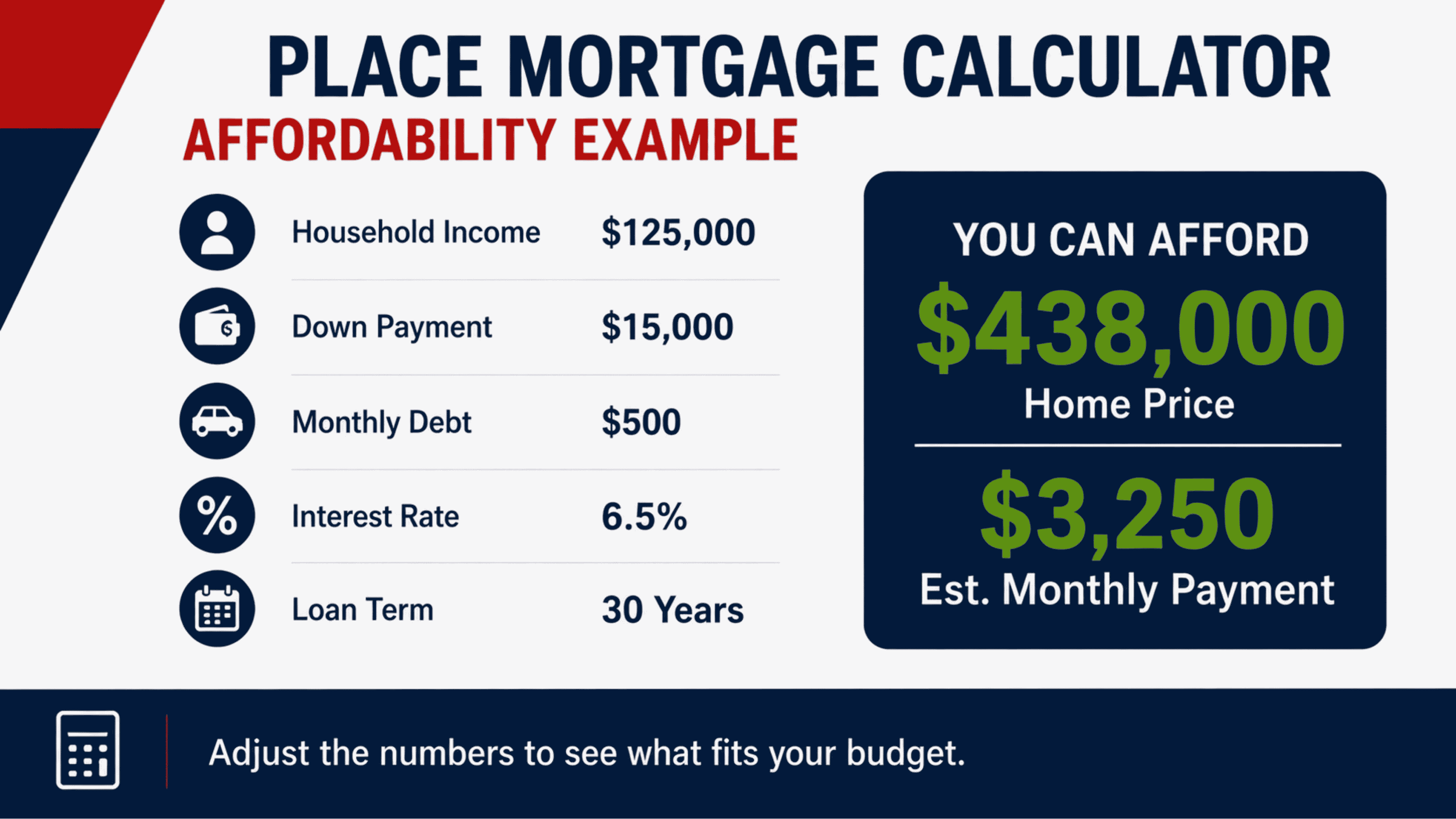
An Example
In the video, I walked through an affordability-calculator example using:
- $125,000 household income
- $15,000 down payment
- $500 per month in existing debt
- 30-year mortgage
- 6.5% interest rate for the example
Using those inputs, the calculator estimated an affordable purchase price of approximately $438,000, with an estimated monthly payment around $3,250.
Moving the purchase price closer to $500,000 pushed the scenario into a range the calculator considered more of a stretch.
That's exactly why I like running these numbers before looking at houses.
You may technically qualify for a certain amount, but that doesn't mean you'll be comfortable making that payment every month.
What you can qualify for and what you actually want to spend aren't necessarily the same thing.
4. How Will Your Mortgage Rate Affect the Move?
Your mortgage interest rate can have a significant effect on your monthly payment.
That's particularly important for homeowners who bought or refinanced when mortgage rates were lower.
You may be sitting on a very attractive mortgage rate today.
Giving that rate up doesn't automatically mean you shouldn't move. But it absolutely deserves to be part of the conversation.
That's why I don't think the question should simply be:
"Is my new interest rate higher?"
The bigger question is:
"Does the new monthly payment make sense for our finances and our life?"
Maybe your family has grown and you genuinely need another bedroom.
Maybe the kids have moved out and maintaining your current home no longer makes sense.
Maybe you want to be closer to family.
Maybe you're ready for a different location or lifestyle.
A mortgage rate is an important financial consideration, but it's only one part of deciding whether moving makes sense.
Run the Numbers Before You Start Looking at Houses
This may be the most important takeaway from the entire conversation.
Don't wait until you've found the house you love to figure out whether you can afford it.
Imagine finding the perfect house.
You love the neighborhood. The layout is exactly what you want. You're already picturing your family living there.
You start getting your current house ready to sell.
Then you finally talk to a lender.
And you discover the payment doesn't work—or there's something on your credit that needs to be addressed before you can qualify.
That's an avoidable disappointment.
Instead, do the financial work first.
Before seriously shopping, I recommend:
- Determine approximately what your current home is worth.
- Determine your mortgage payoff.
- Estimate your net proceeds and available equity.
- Decide what monthly payment you're comfortable with.
- Talk with a lender and get pre-approved.
Now you can start shopping with confidence because you understand what you can realistically afford.

Why Talking to a Lender Early Matters
Online mortgage and affordability calculators are excellent planning tools.
But they're not a replacement for talking with a qualified mortgage professional.
A lender can look more closely at your financial situation, including your income, existing debts, credit profile, available down payment and potential loan programs.
They can also help you understand what your estimated monthly payment may look like at different purchase prices.
And if there's something preventing you from qualifying today, wouldn't you rather find that out before you find your dream house?
That's why we encourage homeowners to have the financing conversation early in the process.
Sometimes the Best Decision Is Not to Move
There's something else that's important to understand:
My goal isn't to convince you to move.
Sometimes we'll run all these numbers and discover that moving doesn't make financial sense right now.
Maybe you'd spend considerably more every month and end up with a home that isn't significantly better than the one you already own.
In that situation, staying put may be the better decision.
But sometimes life makes the decision different.
Your family is growing and you need more space.
You're an empty nester and want to downsize.
Your current home requires more maintenance than you want to deal with.
You need a different location.
Every situation is different.
The purpose of running the numbers isn't to convince yourself to move.
It's to give yourself enough information to make a good decision.
Thinking About Moving in Southwest Indiana?
If you're considering moving up, downsizing, or making another move in Evansville, Newburgh, Boonville, Princeton, Santa Claus, or elsewhere in Southwest Indiana, you don't have to figure everything out on your own.
We can start with a complimentary consultation.
We'll talk about what you're trying to accomplish, take a look at your current home, help you understand its potential market value and begin putting together the numbers for your next move.
There's no obligation to sell your house.
Sometimes you just need to answer the question:
"Can we actually make this work?"
And that's a much better question to answer before you start shopping.
Call or text Trae Dauby at 812-777-4611 or visit DaubyRealEstate.com to start the conversation.
Frequently Asked Questions
How do I know if I can afford to move to another house?
Start by estimating your current home's value, mortgage payoff and potential net proceeds. Then determine what monthly payment you're comfortable with and talk with a lender about what you may qualify to purchase.
How do I calculate the equity in my home?
A simple estimate is to subtract your outstanding mortgage balance from your home's current market value. Remember that gross equity isn't necessarily the amount you'll receive at closing because selling expenses also need to be considered.
Should I get pre-approved before looking at houses?
Getting pre-approved early can help you better understand your buying power and potential monthly costs before you become emotionally invested in a particular property.
Should I use all of my home equity as a down payment?
Not necessarily. How much equity you should put toward your next home depends on your overall financial situation, financing options, desired monthly payment and other needs. This is something worth discussing with your lender and financial professionals before making a decision.
Is it worth moving if I currently have a low mortgage rate?
It depends. A higher mortgage rate can increase the cost of your next home, but finances aren't the only reason people move. Changes in family size, lifestyle, location and housing needs can all influence the decision. The important thing is understanding what the new payment would be before deciding.
Should I sell my current home before buying another one?
Not always. Depending on your finances and available equity, there may be several ways to structure the transaction. We've created additional resources explaining whether you should sell or buy first, how to use your home equity to purchase your next house, and how home-sale contingencies work.
About Trae Dauby
Trae Dauby is the founder of Dauby Real Estate, serving homeowners throughout Evansville, Newburgh and Southwest Indiana. Dauby Real Estate has helped more than 3,500 families with their real estate needs.
Trae regularly creates educational content designed to help homeowners understand the financial and practical decisions involved in buying, selling, moving up and downsizing.
To discuss your next move, call or text 812-777-4611 or visit DaubyRealEstate.com.